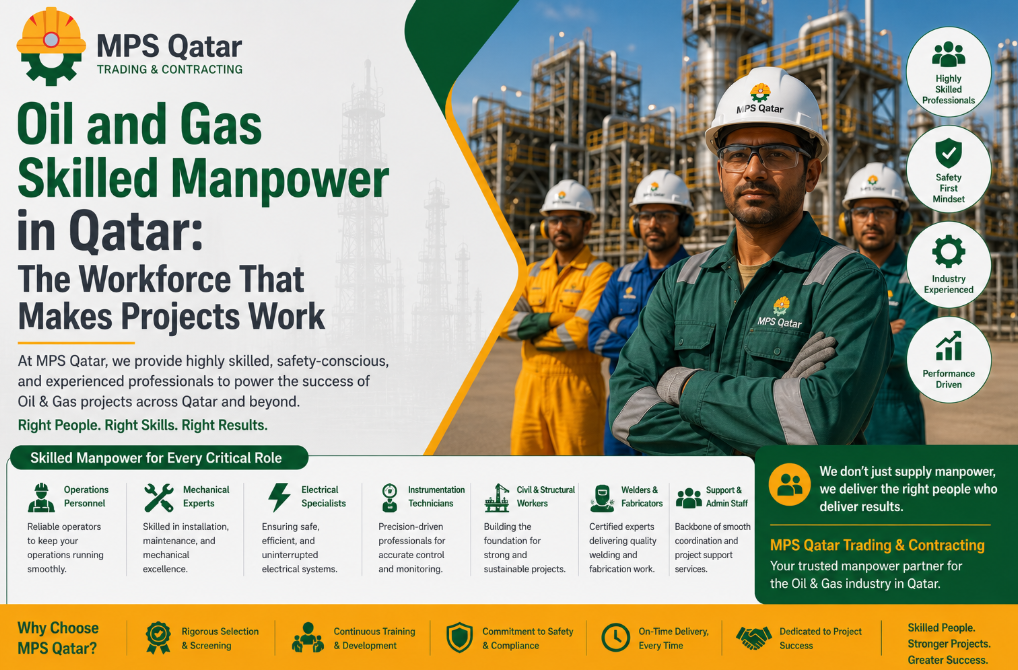
Every oil and gas project in Qatar — from the most complex greenfield LNG train to the most routine plant maintenance scope — ultimately depends on the skill, certification, and commitment of the workers who physically do the work. Engineers design systems. Project managers plan schedules. Procurement teams source materials. But it is the skilled manpower — the welders, pipe fitters, instrument technicians, riggers, scaffolders, HSE officers, and mechanical technicians — who build, maintain, and operate the infrastructure that Qatar’s energy industry runs on.
Sourcing the right skilled manpower for oil and gas work in Qatar is one of the most persistent operational challenges facing the sector. The demand for certified, experienced workers consistently outstrips supply. The certification and documentation requirements are rigorous. Mobilisation timelines are short. And the consequences of deploying the wrong people on safety-critical tasks are severe.
MPS Qatar Trading & Contracting specialises in solving exactly this problem. We provide certified, tested, and experienced oil and gas skilled manpower in Qatar — across all disciplines, all trades, and all project types — with the speed, reliability, and professional management that Qatar’s project industry demands.
What “Skilled Manpower” Really Means in Qatar’s Oil and Gas Context
In the general labour market, “skilled” is often used loosely to describe anyone with some experience in a relevant trade. In Qatar’s oil and gas context, skilled manpower has a more precise meaning — one that carries significant implications for site safety, work quality, and regulatory compliance.
Oil and gas skilled manpower in Qatar means workers who:
Hold verified, current certifications from recognised testing authorities in their specific discipline. A pipe welder must hold a current ASME Section IX qualification. An instrument technician must hold a relevant diploma and be able to demonstrate competence with the specific instruments used on the project. An HSE officer must hold NEBOSH or IOSH certification at a minimum.
Have demonstrable project experience in the specific type of oil and gas work required. Three years of experience installing HVAC pipework in a commercial building does not prepare someone for installing high-pressure process piping in an LNG facility. Experience must be relevant, verifiable, and recent.
Understand and comply with the safety culture of Qatar’s oil and gas industry. This means knowing how permit-to-work systems operate, understanding hazardous area classifications, being able to identify and respond to H2S alarms, knowing emergency assembly point procedures, and approaching every task with a zero-harm mindset.
Can be verified to the client’s satisfaction — meaning their documentation is genuine, their references are real, and their claimed experience matches their actual capability when assessed by a technical interviewer or practical test.
MPS Qatar’s pre-deployment vetting process is specifically designed to identify workers who meet all four of these criteria and to exclude workers who do not — regardless of what their CV says.
The Most In-Demand Skilled Manpower Categories in Qatar’s Oil and Gas Sector
HSE Officers and Safety Professionals
Health, Safety, and Environment is the highest-priority discipline on every oil and gas site in Qatar. Fresh or junior safety officers may earn between QAR 4,000 to QAR 6,000 monthly, while experienced HSE engineers earn between QAR 9,000 to QAR 15,000 depending on project scale, with offshore roles crossing QAR 18,000 due to risk and rotational benefits.
MPS Qatar’s HSE officers hold NEBOSH IGC as a minimum, with senior HSE professionals holding NEBOSH Diploma, IOSH membership, or CMIOSH status. All hold site-specific certifications including H2S Alive, CSE, and WAH. Our HSE professionals understand QatarEnergy’s GEMS (Gulf Environment Management System) requirements and are experienced in conducting toolbox talks, safety audits, near-miss reporting, and permit-to-work compliance on large oil and gas sites.
Instrument and Control Technicians
Instrument technicians are the most technically complex of the skilled trades in Qatar’s oil and gas sector. They maintain and calibrate the sensors, transmitters, control valves, gas detectors, and fire and gas systems that keep plants running safely and efficiently. Experienced instrument technicians in Qatar’s oil and gas sector earn approximately QAR 5,700 per month at technician level, with lead and senior instrument technicians commanding significantly more.
MPS Qatar’s instrument technicians hold relevant diplomas in instrumentation, electronics, or control systems, with field calibration experience using HART communicators and other relevant tools. They are experienced with DCS and PLC systems common in Qatar’s oil and gas facilities including Honeywell, Yokogawa, ABB, and Siemens platforms.
Electrical Technicians and Engineers
Electrical skills are required at every level of oil and gas facility operation — from installation and commissioning of new facilities to maintenance of motor control centres, switchgear, and transformer systems on operating plants. Electrical technicians in Qatar’s oil and gas sector earn approximately QAR 5,700 per month, with electrical shift engineers at senior level earning QAR 12,700 per month.
Mechanical Technicians (Rotating Equipment)
Rotating equipment specialists maintain the compressors, turbines, pumps, and gearboxes that are the mechanical heart of Qatar’s oil and gas processing facilities. These are among the most highly paid technicians in the sector, earning QAR 5,000 to QAR 8,000 per month depending on experience and the complexity of equipment they maintain. MPS Qatar’s rotating equipment technicians are experienced with gas turbines (GE, Siemens, Rolls-Royce), centrifugal and reciprocating compressors, and multistage high-pressure pumps.
Pipe Welders and 6G Certified Welders
Certified pipe welders — particularly those holding 6G qualifications — are among the most valuable and most consistently short-supplied skilled workers in Qatar’s oil and gas sector. Demand for qualified pipe welders far exceeds supply at all times, making a manpower supplier with a pre-qualified resident pool of certified welders an extremely valuable partner. MPS Qatar maintains a dedicated welding workforce covering all major processes and qualification standards.
Riggers and Lifting Specialists
Rigging and lifting operations are among the highest-risk activities on any construction or maintenance site. Qatar’s oil and gas operators require riggers to hold valid rigging certificates, demonstrate knowledge of load charts and crane capacities, and show experience with the specific lifting requirements of oil and gas plant environments. Certified riggers earn QAR 1,800 to QAR 3,200 per month, with rigging supervisors commanding QAR 3,000 to QAR 4,500 per month.
Quality assurance and quality control on oil and gas projects in Qatar is a rigorous discipline governed by international codes and client-specific quality management systems. QA/QC inspectors in Qatar’s oil and gas sector earn QAR 4,500 to QAR 8,000 per month, with senior QA/QC engineers commanding more on complex projects. MPS Qatar supplies QA/QC inspectors experienced with ASME, API, AWS, and ISO quality standards, and familiar with the documentation requirements of major operators and EPC contractors in Qatar.
How MPS Qatar Assesses and Verifies Skilled Manpower Before Deployment
Our multi-stage pre-deployment assessment process is the most rigorous in Qatar’s manpower supply market:
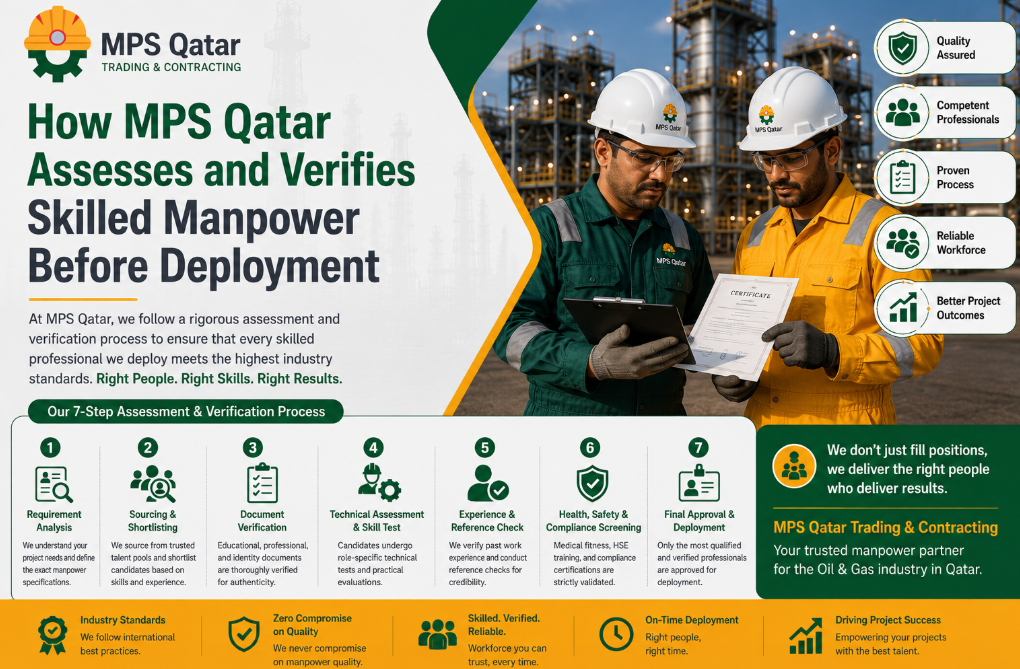
Stage 1 — Document Review: All claimed qualifications, trade certificates, safety certifications, and experience records are reviewed against original documents. Copies are not accepted as final verification. We check issue dates, validity periods, testing authority credentials, and scope limitations on all qualification records.
Stage 2 — Technical Interview: For supervisory and engineering roles, a technical interview is conducted by a senior MPS Qatar technical assessor to evaluate the worker’s understanding of their discipline, familiarity with relevant codes and standards, and ability to apply their knowledge in the context of Qatar’s oil and gas sector.
Stage 3 — Practical Trade Test: For hands-on roles, including welders, pipe fitters, riggers, and scaffold workers, a practical trade test is conducted before any worker is placed on a client project. Welders produce a test weld that is visually inspected and in some cases radiographically examined. Riggers demonstrate correct sling selection and load assessment. Scaffolders demonstrate correct scaffold erection and safety tagging.
Stage 4 — Medical Fitness Verification: All workers hold a current medical fitness certificate. For offshore roles, a more comprehensive offshore medical examination is required.
Stage 5 — Reference Check: Previous employment references are checked for all workers at the supervisor level and above. Project history is validated against the worker’s CV.
Only workers who pass all relevant stages of this process are offered to clients. This is why MPS Qatar’s workers arrive on site ready to work, not ready to be tested.
Frequently Asked Questions
Q: What is the minimum experience level MPS Qatar requires for skilled oil and gas manpower?
Requirements vary by role. For general skilled trades, a minimum of 3 years of relevant oil and gas experience is typically required. For technicians, 5 years is standard. For supervisors and engineers, 7 to 10 years of relevant experience is expected. All experience claims are verified through documentation and reference checking.
Q: Does MPS Qatar supply skilled manpower for both brownfield and greenfield oil and gas projects in Qatar?
Yes. MPS Qatar supplies skilled manpower for greenfield construction projects, brownfield expansion and modification projects, planned maintenance and inspection scopes, and emergency maintenance work across Qatar’s oil and gas sector.
Q: How does MPS Qatar ensure that the workers it supplies actually have the skills they claim?
Through our five-stage pre-deployment assessment process covering document verification, technical interview, practical trade testing, medical fitness confirmation, and reference checking. Workers who do not meet our standard are not placed on client projects, regardless of their claimed credentials.
Q: Can MPS Qatar supply specialist skilled manpower for niche oil and gas disciplines such as cathodic protection, heat exchanger maintenance, or nitrogen blanketing?
Yes, though lead times for highly specialist roles may be longer. MPS Qatar maintains a network of specialist contractors and international recruitment sources for niche disciplines. Contact us with your specific requirement and we will advise on availability and mobilisation timeline.
Q: What happens if the skilled manpower MPS Qatar supplies fails a site competency assessment?
This is rare given our pre-deployment vetting process, but if it occurs, MPS Qatar works with the client to understand the specific competency gap and either arranges additional training or replaces the worker. We do not charge clients for replacements that result from our own qualification assessment errors.